6/10/13

Some Major Earthquake Zones


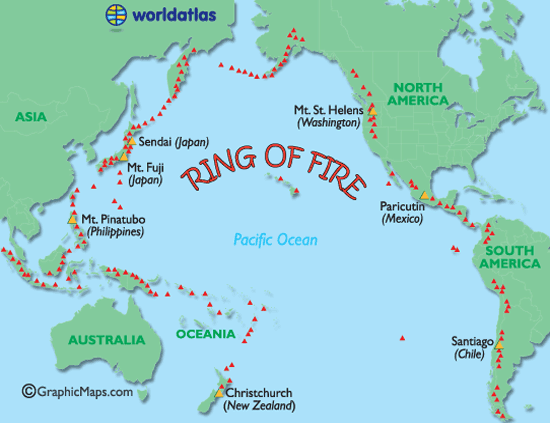
One large are known as the Ring of Fire. It includes the western coasts of North America and South America, and the eastern coasts of Asia. This area forms a ring around the Pacific Ocean. Many earthquakes occur along the Ring of Fire because, the plate movements cause strain to build up in rocks. Eventually, the rocks fracture and shift, and an earthquake occurs.


Mid-Atlantic Ridge.Earthquakes occur along this ridge because the oceanic crust is pulling away from the sides of the ridge. This spreading motion creates strain in the rocks along the ridge.


Eurasian-Melanisian mountain belt. The mountains along this belt were formed by the collision of the Eurasian plate with the African and the Indian plates. These plates are still colliding, and the same forces that are pushing up the mountains also produce numerous earthquakes.


Earthquakes

Earthquakes
- are closely related to the movement of the Earth's plates.
-As the earth plates moves, they press against each other and the pressure builds until one plate splits past another plate.

Faults
-cracks produced by the movement of the plates.

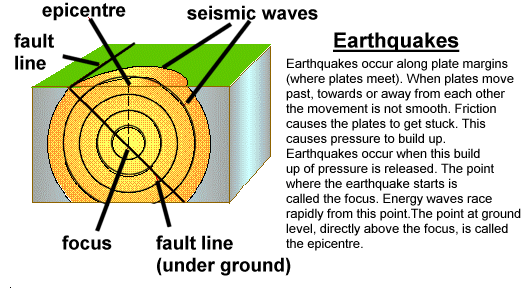
Focus/Hypocenter
-the point where the pressure is relieved.

Epicenter
- the point on the Earth's surface directly above the focus.


Vibrations or shock waves are sent out in all directions from the focus. Smaller waves are often sent out after the earthquake. These are called aftershocks.


Types of Plate Movements:
1.Divergence
-occurs when 2 plates move away from each other. It takes place at the boundary of the oceanic plates, and forms a new seafloor ----> seafloor spreading process.

2. Convergence
-occurs when 2 plates move toward each other.The 2 plates,,thus, collide. The impact of their collision destroys some parts of the crust.

3 Types of Convergence:

a. between a continental plate and an oceanic plate
> a thin oceanic plate collides with a thick continental plate, resulting in the sinking of the oceanic plate under the continental plate ---> subduction process.

b. Between 2 oceanic plates
- 2 oceanic plates collide,resulting in the subduction of one beneath the other. Magma from the mantle rises, forming volcanoes.


c. Between 2 continental plates
- two continental plates collide, resulting in the slight forcing of one plate under the other, but suduction does not take place.


3. Lateral Slipping
- occurs when 2 plates move sideways against each other. The movement is not smooth due to friction and 2 plates get stuck. Pressure builds up and when suddenly released, the plates jerk apart. This results an earthquake.

6/6/13

Theories About the Earth's Movement

Theory
- an idea that is used to explain observed facts.

(Unnamed Theory) 1908
frank B. Taylor ( 1860-1939 )
- an American geologist
- suggested that the Earth had not shrunk. He said that the continents formed from 2 large continents, one located over each pole. These continents broke apart in a ''creeping'' motion. No one really believed Taylor's idea and most scientists just ignored it.

Mohorovicic Discontinuity/Moho (1909)
Andrija Mohorovicic (1857-1936)
-Croatian scientist
-discovered that the speed of seismic waves increases abruptly by 32-64 km beneath the Earth's surface.
This change in the speed of the waves marks the boundary between the crust and the mantle. This boundary is called the Mohorovicic Discontinuity or Moho.

Continental Drift Theory (1912)
Alfred B. Wegener (1880-1930)
-German scientist
-claimed that the continents once formed part of a single landmass, which he named Pangaea, meaning ''all lands.'' Surrounding Pangaea was a huge ocean called Panthalassa meaning ''all seas.''

According to Wegener, about 200 million years ago, Pangaea began breaking up into smaller continents, which drifted to their present locations. He speculated that this motion may have crumpled the Earth's crust in places, thus producing mountain ranges.


Pieces of Evidence: the way that South America fits with Africa. The same kinds of plant and animal fossils were also found in both places. Despite these pieces of evidences, scientists did not agree with him. The reason was because he could not explain why or how continents moved.

Wegener spent the rest of his life searching for evidence to prove his theory. He died 1930 without convincingly explaining what caused continents moved.

Seafloor Spreading  ( 1960)
- hot molten rock was flowing up through cracks in the floor of the Atlantic Ocean.
>Molten rock flowing from the crack formed the mountains.
As the molten rock hardened, it pushed older ocean floor apart ----> Seafloor Spreading.


Plate Tectonic Theory
tectonic - ''builder''
-this theory suggest that the crust of the Earth is made up of number of large rigid plates and a number of smaller ones. Most of the plates are named for the continents that rest them.

12 major plates and 38 minor plates have been identified.

Plates with continents move relatively slow. They move about 2cm each year. Those without continents move faster, about as much as 12 cm per year.


Layers of the Earth

Layer of the Earth:

*Crust 
-thin,solid,outermost covering of the Earth.
- makes up 1% of Earth's Volume.
> 2 kinds of Crust
~Oceanic Crust 
-beneath the oceans.
5-10 km thick
~Continental Crust
- beneath the continents
-70 cm thick
-thickest beneath mountains


*Mantle
-located below the rust
-2,870 km thick
- 80% of the Earth's Volume
- 2/3's of the Earth's mass.
'' uppermost part of the mantle is solid.''
''solid portion makes up lithosphere.''
~Lithosphere
-65-100 km thick
''below the lithosphere is the asthenosphere''
~Asthenosphere
-region of the mantle
- 200 km thick
~Plasticity
-the ability of the solid to flow.


*Core
- below the mantle
-center of the Earth
~Seismic waves 
- are the vibrations that travel through the Earth.
''Earthquakes & Explosions - produce seismic waves.''
''The outer portion of the core is a dense liquid about 2,680 km diameter.''
Innercore & Outercore - 19% nearly (1/3) mass of the Earth's volume.